Customer review
In the end, everything on the farm comes down to the same question – what is left in the trailer once the crop has been harvested?
For Radašin Radosavljević, a farmer from the Svilajnac area, the answer was not easy to find this year. The season was exceptionally dry, with very little rainfall, which made it particularly important to see how the crops would perform where Contur AntiStress had been applied.
Radašin used the product on two crops – corn and sunflower. Both hybrids were from the LG group, but the approach was not the same for the two crops.
In corn, AntiStress was applied as a foliar treatment together with the crop protection treatment, at the 5–7 leaf stage, at a rate of 0.5 L/ha.
In sunflower, the approach was somewhat different. AntiStress was applied for as long as it was possible to enter the crop with a sprayer, also at a rate of 0.5 L/ha.
But simply looking at the crop and saying that it looked good was not enough for Radašin.
He wanted to see the numbers.
That is why he also left untreated areas in the fields, allowing him to compare the yields and see whether the difference could actually be measured once the crops were harvested.
When a Field Result Becomes a Number
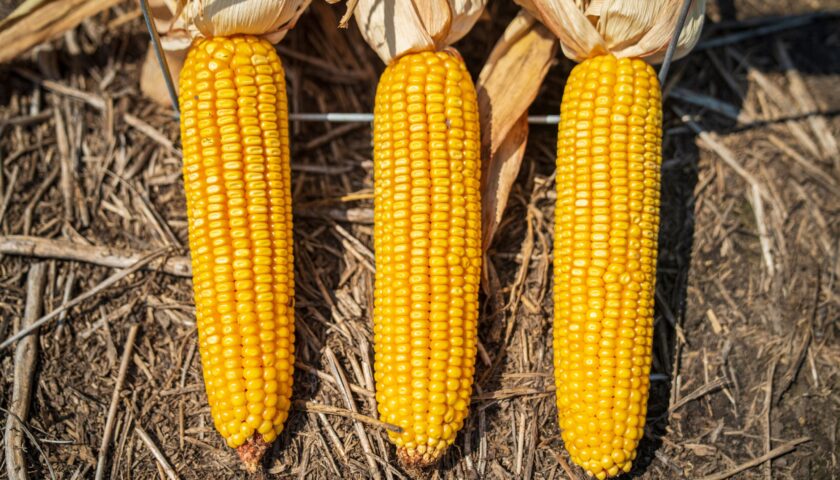
Corn may be the best example.
On the part of the field where AntiStress was not applied, the yield was 5,890 kg/ha.
On the treated part, the yield was 3.2% higher.
That means approximately 6,078 kg/ha, or around 188 kg more per hectare.
When this difference is calculated using the corn price at the time, 22 RSD/kg, it represents approximately 4,147 RSD/ha in additional crop value, before deducting the cost of the treatment itself.
At first glance, 3.2% may not sound like a large figure. But when the percentage is translated into what a farmer actually sees on the scale, the picture looks different – almost 190 kilograms more corn from one hectare.
And then there is sunflower.
On the untreated part of the field, the yield was 3,740 kg/ha, while the part treated with AntiStress recorded a 2.8% higher yield.
That corresponds to approximately 3,845 kg/ha, or around 105 kg more per hectare.
At a sunflower price of 50 RSD/kg, those additional 105 kilograms represented approximately 5,236 RSD/ha in additional crop value, again before deducting the cost of the treatment.
Taken together, the two results represent approximately 9,383 RSD/ha in additional crop value, based on the difference between the treated and untreated areas.
| Crop | Untreated | Treated | Difference | Price | Additional value |
|---|---|---|---|---|---|
| Corn | 5.890 kg/ha | 6.078 kg/ha | +188 kg/ha | 22 RSD/kg | +4.147 RSD/ha |
| Sunflower | 3.740 kg/ha | 3.845 kg/ha | +105 kg/ha | 50 RSD/kg | +5.236 RSD/ha |
| Total | — | — | — | — | +9.383 RSD/ha* |
Of course, no field result should be viewed separately from the season in which it was achieved.
And this year, water was scarce.
Very scarce.
Under such conditions, it was precisely this that made it interesting to observe how the crop would respond where AntiStress had been applied.
Radašin did not start from the assumption that the product would perform a miracle. He did what farmers know best – he left room for comparison and let the field have the final say.
Because once the crop is harvested, the story is no longer simply about how it looked during the growing season.
What remains is the yield.
What remains is the difference between the treated and untreated areas.
And, ultimately, what remains is the question that matters most to every farmer – can what was done in the field also be seen in the final calculation?
In Radašin’s case, this year’s comparison showed a difference in both corn and sunflower.
And that is precisely why results from real farms have their value – not as a promise that every field will deliver the same result, but as the experience of one farmer under very specific production conditions and an exceptionally dry growing season.